A good tulip border is legible from a distance and generous up close. Height, flowering band, colour and the behaviour of surrounding perennials should work together rather than compete for the same moment.
Draw three layers
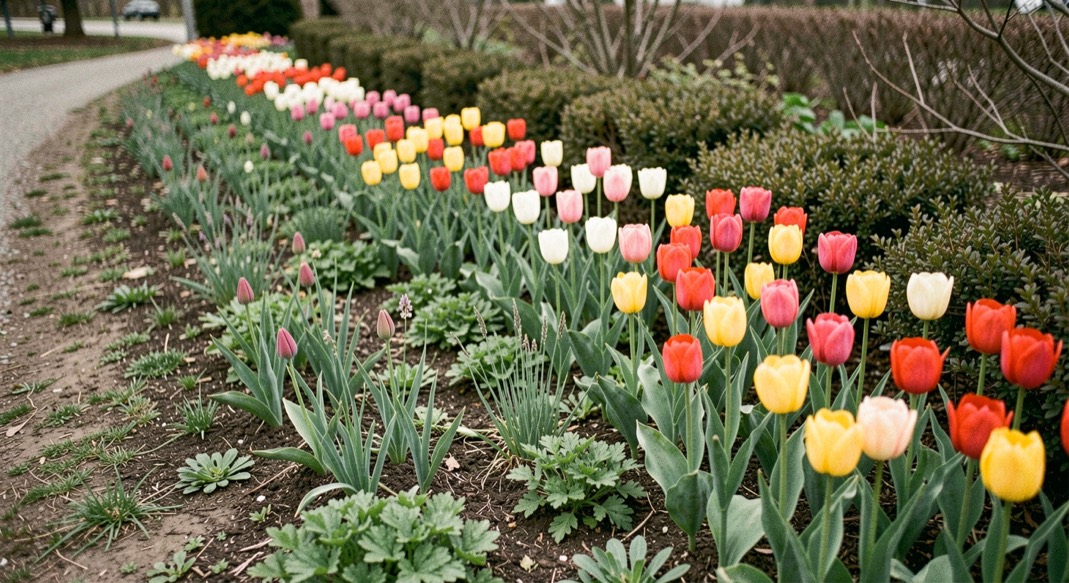
Use a low foreground, a middle band and a taller back layer as a first sketch. The flowers do not need to open together: foliage, stems and emerging perennials can carry the transition between bands.
Keep a simple plan of where the bulbs went. That small record makes next autumn's decisions easier and helps distinguish a missing plant from a late one.
Build around the season
Start with the early tulips, then place a mid-season group such as Darwin Hybrids behind it. Late doubles and parrots can close the sequence when their scale has enough space to be seen without crowding the earlier cups.
The colour guide guide is useful when a planting needs a quieter bridge between two strong colours. Use broad families instead of assuming a photograph is a permanent colour standard.
Make the promise modest
A design can be clear without promising that every bulb will return. Treat perennialisation as a decision to test in the conditions you have, and place annual bedding choices where a replacement is easy.
For practical groundwork, return to planting and care. For the evidence rules behind the garden tags, read the methodology.
Continue the reading
Compare flowering bands, colour notes and planting.